Showing posts with label Articles. Show all posts

Thursday, April 25, 2013

The U.S. Government as Venture Capitalist: Why Go There?

I had a rousing debate on Kudlow tonight about the Fisker story that's got a lot of folks like Larry K crying "Solyndra squared!"

Not so fast, dude. Brad Plumer covers the details here, but Fisker Automotive is a small company that has been trying to break into the electric car market but now teeters on the edge of bankruptcy. So... it happens, right? Not every pony finishes the race. What's the big deal here?

From the morning's New York Times:

No electric vehicle initiative backed by Washington seems more of a debacle than Fisker, which was given a $529 million federal loan in 2009 to advance the project. Two years later, after Fisker repeatedly missed production targets and other deadlines, the Energy Department suspended the loans.

Private investors also sunk about $1 billion into the company, but it's the loan by the U.S. government that a) genuinely rankles free marketeers like Kudlow, and b) provide a juicy talking point for Obama admin critics.

To be clear, the Energy Dept. froze the loan after $192 million back in June of 2011, and seized $21 million from the company's reserves on Monday. Also, as Plumer notes:

The Obama administration... stressed that Fisker was an anomaly. Nicholas Whitcomb, who directed the Energy Department's advanced-vehicle loan program until recently, testified (pdf) that $8.4 billion in advanced-vehicle loans have been given out to five auto companies so far. While Fisker has performed poorly, he said, loans to firms like Ford, Nissan, and Tesla have helped build factories and are all scheduled to be repaid.

Whitcomb also noted that Congress explicitly provided a $10 billion credit subsidy to cover losses and bad loans, thereby acknowledging the "inherent risks of funding new and innovative technologies.

One might also note, as an administration official did during testimony today, that about 2 percent of the government's loans have defaulted, and there's of course no venture capital firm out there that would come anywhere close to that level of success (if they bat 500, they're doing great).

But putting aside all the political BS, the case raises good questions: Why should the U.S. government provide venture capital? And if there's a rationale, how much should they provide, and on what terms? What is an acceptable failure rate? Is it zero, as Kudlow et al would argue?

The question of should the government backstop investments in new areas of research is actually an odd one, because it's been doing so since before we were even a nation (the provisional government subsidized machine tools for weaponry to fight the British -- in fact, much of what followed grew out of defense spending). As I stressed on the Kudlow show, you simply cannot find an economically transformative innovation, from railroads to transistors to lasers to fracking to the Internet, GPS, nanotech, and so on, that doesn't have a government fingerprint on it somewhere.

There are numerous reasons for this history. Absent early investment support, not enough private capital will be willing to risk early support of an unproven technology. Scale is prohibitive when contemplating the railroads, the internet, or the smart grid. Credit can disappear at critical moments, as in the financial meltdown out of which the electric automotive loan program arose.

Our international competitors understand this, and they're far less squeamish about it. Public/private partnerships are prevalent in Germany for example, where manufacturing policy is an explicit area of intervention.

So, does all that mean taxpayers have to live with the occasional failure in order to reap the benefits of transformative innovations like those listed above? Probably so, but while I'm clearly a believer in public investment, I don't love the idea of the federal government picking this firm over that one. The record shows that doing so is not anywhere near as problematic as critics maintain, but let's be real... there's just a lot of ways in which that's asking for trouble.

Perhaps a better way is some sort of arm's length arrangement, where national policy picks broad areas of innovation to support where markets will underinvest, but assigns the choice of specific firms to groups of private experts and investors who will also have their own skin in the game. Needs work, but that's the idea.

How to Handle Stress (Hint: Don't Ignore It!)

I can't entirely escape stress. No one can. Our collective experience requires that we endure at least a certain amount of anxiety, especially when we strive for bigger goals that take us outside our comfort zone. However, striving, and even stressing (a bit) are actually important to success, so I will try to give some insight into how I manage it, so it doesn't rule me and get in the way of achieving my goals. The key is not to run from it, but to embrace it so it doesn't overwhelm or become debilitating.

When presenting myself to the world, whether in business or entertainment I generally want to project an air of confidence, of being in control. I think this is common because we all want the outside world to get the impression that we are on top of our game and that we can reliably get the job done. We often ignore stress, or pretend that nothing gets to us; that we are undaunted. The causes of stress are also always shifting and changing, depending on the specifics of what is being demanded of us. Identifying the stressors may prove to be difficult or illusive.

So for these reasons, my main objective is to attempt to pay attention, acknowledge and almost welcome the stress. Stress is an indicator. It yields information and insight. It's important. I never all-out reject stress. I listen to it. I let it tell me what it is I should be aware of. Once I have recognized what the stress is trying to tell me, only then will I relieve it of its duty, dismissing it wholly, yet respectfully.

Those that ignore their stress and pretend that it doesn't exist allow it to build up inside, letting it fester until it erupts in unmanageable ways. Recognizing your limitations, but always knowing that you are able to grow to overcome them, is the way around stress. It is the type of stress that you can't see, or the stressors that you can't overcome, that ultimately break you. Meditation (and not necessarily the New Age variety) is of utmost importance. Make time to take a personal inventory . I don't flog myself for being nervous, I simply observe and breathe.

Laughter is a great way to relieve stress. Don't let your goals become too important, and try to maintain humility in every moment. Your goals and objectives are only part of your whole life experience. Being healthy and happy is first, and nothing should be so important that it precludes you from taking care of your mental and physical health. Regular exercise is another important way I manage stress. It is not only medically proven to relieve stress but also makes you stronger, keeps your body and brain chemistry in balance, and offers a necessary respite from work. I find this provides an invaluable perspective, enabling me to tackle problems, after stepping away from them, with renewed vision.

Wednesday, April 24, 2013

After Boston: Why It's Important That We Keep Asking 'Why?' 'huffingtonpost'

"I, and all of the law enforcement professionals, are hoping for a host of reasons that the suspect survives," said Massachusetts Governor Deval Patrick on Saturday, "because we have a million questions, and those questions need to be answered."

Foremost among those questions is, why? Or, as NBC's Pete Williams put it on Meet the Press, "the biggest question for investigators now is a) you know, why did he turn this way?" This sentiment was echoed by Doris Kearns Goodwin, who recounted the celebration that ensued in the bar she was in when Tsarnaev was captured: "Everybody was just screaming, 'thank God we got him alive,' because they want the answer to the question, why?"

A lot of the who, what, where and how of the bombing and what led up to it have already been answered and, no doubt, more details will eventually be filled in. The why, however, is the more elusive question. But it's also a crucial one. And the why we need answered has to do with more than just questions about Chechnya and Russia, and the conflict between the two. We also need to know why we have so many disaffected young men in our culture, and what compels them to act out that disaffection in violent ways.

I'm in no way suggesting that "society" is to blame for these unspeakable murders, nor that the surviving Tsarnaev brother should, in any way, not be held fully accountable. But to understand is not to condone, and conflating the two only makes it more likely that other similarly violent incidents will happen, more lives will be lost, more families shattered.

Moving forward, steps will certainly be taken to make public events more secure. Questions will be asked about where and how the two suspects got all their firearms and explosives. More cameras will be added to further ensure that, when the next incident happens, the perpetrator can be quickly identified. That's all as it should be, but taking those steps doesn't preclude us from asking, and trying to answer, why such tragedies happen in the first place. We should be trying to stop these horrors at every point in the process, not just at the end stage.

As Simi Singh Juneja, who also gave birth to a son 19 years ago, blogged on HuffPost:

    As a mother, I seek to know why young men are capable of such violence. What escapes us that motivates young men to act out in dark ways? If we don't ask and seek to answer these questions and simply rush to vengeful judgment, how are we going to slow this cycle and possibly prevent future tragedy? Virginia Tech, Tucson, Aurora, Oak Creek, Newtown, and now Boston all constitute sacred reasons to figure out why these young men like to blow things up and go out in a blaze of glory.

So what is it that initially puts young men on the path to seeking out violence? With Tucson, with Newtown, with countless other places, and now with Boston, the justifications may differ, but the end results have a lot in common. And so, likely, do the beginnings.

"Evil may not have a single face, but it can be reliably found within one kind of body: that of an angry man in his late teens or twenties," writes Lisa Miller in New York magazine. "Angry. Young. Men. The description doesn't explain the motivations behind every notorious bloodbath, but it's a place to start -- perhaps the only place to start."

Obviously, not every angry young man turns to murderous violence, but that anger and disaffection manifests in plenty of other dangerous ways. According to the National Gang Center, from 2001 to 2010, there was a significant increase in gang activity -- even as overall crime declined. In 2010, there were an estimated 756,000 gang members throughout the country, and from 2009 to 2010, gang-related homicides increased 10 percent in large cities. In 2010, suicide was the third leading cause of death among Americans aged 15 to 24. In that age range, suicide accounts for 20 percent of all deaths each year.

In 2008, writer and technologist Phil Groman looked at the common elements found in gangs and radical Islamist groups. "One salient parallel between both movements is the presentation and mobilization of violence as an attractive solution to disempowered youth," he writes. "In rejecting formal society, both movements offer a parallel social order that awards status through violence and violent rhetoric." He concludes that one of our challenges "as parents, teachers and community leaders" is to "understand and address the grievances that drive young people toward seeking empowerment."

A special report in 2010 by Colonel John Venhaus for the U.S. Institute of Peace specifically addresses the appeal of al Qaeda to young men, but his findings clearly have wider relevance. "Al-Qaeda's ubiquitous message of anti-Muslim oppression and global jihad appeals to the developmental needs of adolescents," he writes. "Potential recruits have an unfulfilled need to define themselves. Al-Qaeda's ability to turn them to violence is rooted in what each seeks: Revenge seekers need an outlet for their frustration, status seekers need recognition, identity seekers need a group to join."

He notes that Umar Farouk Abdulmutallab, the so-called "underwear bomber," once wrote: "I do not have a friend, I have no one to speak to, no one to consult, no one to support me, and I feel depressed and lonely. I do not know what to do." Those feelings, says Venhaus, are exactly what al Qaeda looks for. "The potential al-Qaeda recruits who live in this highly charged media environment are vector-less energy looking for guidance and direction," he writes. "They want to understand who they are, why they matter, and what their role in the world should be. They have an unfulfilled need to define themselves, which al-Qaeda offers to fill."

Vector-less energy looking for guidance and direction. That certainly describes not only young males susceptible to turning to radical Islam, but young males turning to gangs. And it also seems to describe the Tsarnaev brothers, whose friends and acquaintances seem uniformly shocked that the two were behind the bombing.

Dzhokhar, the younger brother now in custody, attended the Cambridge Rindge and Latin School, where he was a star wrestler. Until last week he was a sophomore at the University of Massachusetts at Dartmouth. His brother Tamerlan attended community college for a few years and was a Golden Gloves boxing champion who aspired to be an Olympian representing the same country he would later attack. Yet he also reportedly created a YouTube channel featuring videos that extolled Islamic fundamentalism.

So how did they get from there to here? Did social media play in this trajectory? Obviously, social media allows groups, both good and bad, to coalesce regardless of physical proximity. But even as social media can increase connection of a certain kind, they can also disconnect us from those around us, or even ourselves. When feelings of disaffection or alienation (or vector-less energy) are already there, do social media amplify them?

As David Remnick writes in the New Yorker, Dzhokhar's Twitter feed was a "bewildering combination of banality and disaffection." Examples from the last year include:

"a decade in america already, I want out"

"The value of human life ain't shit nowadays that's #tragic"

Gregory Shvedov is the editor of the Moscow-based website Caucasian Knot. "These days there are social networks, and people make their decisions from them," he told Remnick. "I would not be surprised if they had another life over social media." Concludes Remnick: "The digital era allows no asylum from extremism, let alone from the toxic combination of high-minded zealotry and the curdled disappointments of young men."

Or, as Andrew Sullivan put it, "This is a reminder that we live in a new world: where the Internet can give people ideas, can turn mellow stoners into paranoid mass-murderers. And a reminder that we live in the same world."

Of course, it's not that the Internet is giving these young men ideas -- after all, killing people is a very unoriginal idea that long predates the Internet or social media -- but, in some cases, it is fostering a sense of identity, albeit a poisonous one, that they're not getting elsewhere. Are they, as Shvedov implies, so desperately creating an online social world -- one with belonging, status and purpose, however odious -- that they're missing in the real world? What is it about our definition of male success that makes these young men feel alienated from it? "These crimes," said forensic psychiatrist Michael Welner to Lisa Miller, "are very much about the evolution of masculine identity."

So where is that evolution heading, and what can be done to help it evolve in productive -- rather than destructive -- ways?

Clearly there are no magic answers to these questions, but it's in all our interests to keep asking them.

Tuesday, April 23, 2013

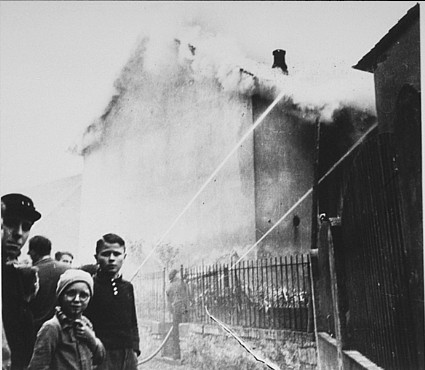
Article: Did Hitler Burn Jews ?


As the synagogue in Oberramstadt burns during Kristallnacht (the "Night of Broken Glass"), firefighters instead save a nearby house. Local residents watch as the synagogue is destroyed. Oberramstadt, Germany, November 9-10, 1938. 
— US Holocaust Memorial Museum

On the night of November 9, 1938, violence against Jews broke out across the Reich. It appeared to be unplanned, set off by Germans' anger over the assassination of a German official in Paris at the hands of a Jewish teenager. In fact, German propaganda minister Joseph Goebbels and other Nazis carefully organized the pogroms. In two days, over 250 synagogues were burned, over 7,000 Jewish businesses were trashed and looted, dozens of Jewish people were killed, and Jewish cemeteries, hospitals, schools, and homes were looted while police and fire brigades stood by. The pogroms became known as Kristallnacht, the "Night of Broken Glass," for the shattered glass from the store windows that littered the streets.

The morning after the pogroms 30,000 German Jewish men were arrested for the "crime" of being Jewish and sent to concentration camps, where hundreds of them perished. Some Jewish women were also arrested and sent to local jails. Businesses owned by Jews were not allowed to reopen unless they were managed by non-Jews. Curfews were placed on Jews, limiting the hours of the day they could leave their homes.

After the "Night of Broken Glass,"life was even more difficult for German and Austrian Jewish children and teenagers. Already barred from entering museums, public playgrounds, and swimming pools, now they were expelled from the public schools. Jewish youngsters, like their parents, were totally segregated in Germany. In despair, many Jewish adults committed suicide. Most families tried desperately to leave.
Key Dates

OCTOBER 28, 1938
GERMANY EXPELS POLISH JEWS
About 17,000 Polish Jews are expelled by Germany and forced across the border with Poland. Poland refuses to allow the Jews to enter. Most of the deportees are stranded in the no-man's-land between Germany and Poland near the town of Zbaszyn. Among the deportees are the parents of Herschel Grynszpan, a 17-year-old Polish Jew living in Paris, France.

NOVEMBER 7, 1938
GERMAN DIPLOMAT SHOT IN PARIS
Herschel Grynszpan, a 17-year-old Polish Jew living in Paris, shoots Ernst vom Rath, a diplomat attached to the German embassy in Paris. Grynszpan apparently acts out of despair over the fate of his parents, who are trapped along with other Polish Jewish deportees in a no-man’s-land between Germany and Poland. The Nazis use the shooting to fan antisemitic fervor, claiming that Grynszpan did not act alone, but was part of a wider Jewish conspiracy against Germany. Vom Rath dies two days later.

NOVEMBER 9, 1938
JOSEPH GOEBBELS DEMANDS RADICAL ACTION
German propaganda minister Joseph Goebbels delivers a passionate antisemitic speech to the Nazi party faithful in Munich. The party members are gathered in commemoration of the abortive Nazi Putsch of 1923 (Adolf Hitler’s first attempt to seize power). After the speech, Nazi officials order the Storm Troopers (SA) and other party formations to attack Jews and to destroy their homes, businesses, and houses of worship. The violence against Jews lasts into the morning hours of November 10th, and becomes known as Kristallnacht--the "Night of Broken Glass." Several dozen Jews lose their lives and tens of thousands are arrested and sent to concentration camps.

NOVEMBER 12, 1938
NAZIS FINE JEWISH COMMUNITY
The Nazi state imposes a fine of one billion Reichsmarks ($400,000,000) on the Jewish community in Germany. Jews are ordered to clean up and make repairs after the pogrom. They are barred from collecting insurance for the damages. Instead, the state confiscates payments owed by insurers to Jewish property holders. In the aftermath of the pogrom, Jews are systematically excluded from all areas of public life in Germany.
                                                                   ushmm.org

Monday, April 22, 2013

Before you read this article, be warned: you may never want to eat again.

You probably already know that our food supply is contaminated. But did you know that the FDA (Food and Drug Administration) allows a certain amount of rat excrement, insect heads and maggots in the food supply, along with a number of other contaminants?

The FDA published a pamphlet, "Levels of Natural or Unavoidable Defects in Foods That Present No Health Hazards to Humans," instructing food producers as to what is allowable. They claim that "defect levels do not represent an average of the defects that occur in any of the products -- the averages are actually much lower." Examples of what is allowed under these "regulations," would include: five fly eggs per 250 ml or one or more maggots per 250 ml in canned orange juice; 30 fly eggs per 100 grams in tomato paste, pizza and other sauces; nine milligrams or more of rodent excreta pellets per kilogram in wheat; and an average mold count of 15 percent in cranberry sauce. How does the FDA consider this acceptable? Aren't they supposed to be looking out for the interests of the consumer by aiming for purity in the food supply?

In addition to the presence of insect parts, fly eggs and fecal matter, our food supply is threatened by bacteria (such as those that cause botulism and e. coli) and parasites (such as the type that causes dysentery). Water contamination and unsanitary conditions in which the food is raised and processed are often the culprits.

A new study also reveals that high fructose corn syrup (HFCS) - already an unsafe sweetener used in most processed foods - contains significant levels of mercury. Mercury was identified in almost a third of 55 brand names foods and beverages where HFCS is indicated as a first or second ingredient. Mercury, as we know, is highly toxic and could lead to brain damage, blindness and deafness.

Besides insect parts, maggots, excrement, parasites, bacteria and mercury, our food supply can be contaminated with agrochemicals, lead and other heavy metals, animal and drug hormone residue and GMOs (Genetically Modified Organisms).

The time has come where the only way to protect yourself is to buy organic or, if possible, to grow your own food.